


Street Light Poles
Founded in 2009, FOREVER LIGHTING is a pioneer in steel poles, solar street lighting, and energy management. We are dedicated to technology innovation, to satisfy customers' needs with our profession and efficiency, and offer the most reliable and lasting steel pole, led street light, and solar street lighting technology. The advantage of our products comes from product quality and cutting-edge technology. Our vision lies in bringing people a lighter future and building our international brand.
Why choose us
Advanced Equipment
We own advanced high-tech full automatic numerical control mechanization production and inspection machines mainly for lighting poles, LED lamps, solar panels lithium batteries, etc.
Competitive Price
With Lower production costs, we enjoy more pricing advantages. Hence we provide competitive prices for customers around the world as much as possible to achieve win-win.
Broad Market
Now we are present in more than 117 countries and regions around the world. We export about 100,000 streetlights per year, bringing public lighting to rural areas without electricity while also accompanying the development of smart cities.
Quality Guaranteed
We take great importance on quality management systems in each process. Each of our products has passed the Raw Material&Semi-Products testing and verification. In addition, warranty statements are also available.
Good Service
We will assist you in all stages from the initial analysis of the project, with the most suitable solar solutions provided by our experts which in compliance with current lighting standards and your budget.
Complete Qualifications
Our factory has passed ISO9001, ISO14001, and ISO45001 certifications, and street lighting products have passed CE, IEC, ROHS, etc certifications and IP66, IES, LM80 tests, etc. If you have some other certificates for specific project requirements, pls consult us.


Why Our Poles
As a professional manufacturer and supplier of steel poles in China

Top Material
Eternal Sunlight stick to choose raw material with mill certificate from large company famous brand to ensure quality.The material with Q345B/A572, Q235B/A36, Q460 ,ASTM573 GR65, GR50 ,SS400, SS490, ST52 and SS304 for optional.

Laser Cutting
◇ High precision: the positioning accuracy of laser cutting is 0.05mm, and the repeated positioning accuracy is 0.02mm.
◇ Narrow slit: the incision width is generally 0.10 ~ 0.20mm.
◇ The cutting surface is smooth: the roughness of the incision surface is generally controlled within Ra12.5.
◇ Fast speed, Fast speed: the laser cutting speed can reach 10m/min, the maximum positioning speed can reach 70m/min.
◇ Good quality, no damage.

Robot Welding
Precision welding,makes the street light pole with small weld, high efficiency and uniform, beautiful appearance.

Hot Dip Galvanizing
Inside and outside surface anti-corrosion treatment by hot dip galvanized more than 80um thickness, which is in accordance with GB/T13912-92 standard.Hot-dip galvanizing prevents rust and corrosion when the street light pole exposes to air.

Powder Coating
With both 360°machine and manual spraying to make led street light poles strong adhesion & strong Anti-ultraviolet. The surface is not peeling even with blade scratch (smooth, color and luster are identical.).Various colors for option.

Strong&Durable
ESTERAL SUNLIGHT assure you all tapered pole,octagonal pole,round pole,and square pole could bear wind resistance 150km/=41.67m/s,which applied in led street lighting,solar street lighting etc.
Introduction of Street Light Poles
Street light pole refers to the column structure used to support street lamps so that they can be stably installed beside or in the center of the road, usually at a certain height to project the light over a longer distance and provide better lighting effects. In addition, the poles allow the angle and height of the lamps to be adjusted as needed.
Street light poles are usually made of metal materials such as steel and aluminum alloys, which are used to hold street lights and provide support. Modern street light poles can also be fitted with sensors and control systems to realize intelligent functions such as automatic dimming and timed switching. In addition, video surveillance, environmental monitoring, and other equipment can be integrated to realize the construction of a smart city.
Smart Technology
Technology has ways of evolving and street light poles are no different. A light pole has the potential to act as a hub for gathering information about city services from sensors and business information from databases. There's the great possibility of bringing it all together on one platform to engage with the local community. Since these fixtures are placed in public areas, various city services could gather information by installing video surveillance for traffic, sensors for mass transit, and communication area modules with information kiosks. All of this would be integrated and packaged for someone to easily deliver information to people through their smartphones.
Pedestrian Safety
Lighting poles provide security and safety for those driving on the road or those walking nearby. As they are spaced out appropriately between each other, they can eliminate dark spots and alert people of other potential hazards like trees, shrubs, or larger buildings. This not only protects the driver but also the pedestrians walking or biking along. Moreover, the appropriate spacing of street lights also prevents glare from distracting drivers on the road, so they know where they're driving and who's in view. More lighting can also help deter criminal activity in certain cases and give people some peace of mind whenever they are outside. Better coverage of blind spots or dark areas lets people know where others are and what is happening at every moment.
Aesthetics
The perfect street lighting pole not only does its job effectively but can also look good in doing so. They can add a beautiful ambiance, beauty, and appeal to a plain, open space. Depending on the design, they can also blend well with historic infrastructures, business areas, or any residential community. Good lighting, in general, can also be used to effectively highlight other features of an area such as statues, fountains, gardens, and so much more. Seeing more of your surroundings can help you appreciate the area you frequent often.
Money Saving
Street light poles made of steel are constructed to last longer, meaning less costs for maintenance and replacement. The energy savings generated by LED lighting systems lead to huge cost savings in the long run for municipal authorities.
Sustainable Solutions
In an age where environmental consciousness is paramount, street light poles are evolving to embrace sustainable solutions. LED lighting technology, motion sensors, and smart control systems are revolutionizing the way we illuminate our cities, reducing energy consumption and carbon emissions without compromising on quality or performance. By embracing eco-friendly materials and energy-efficient lighting solutions, street light poles are not just illuminating our streets but paving the way for a greener, more sustainable urban future.
Common Types of Street Light Pole
Tubular Poles: Tubular poles are in most common use, it is very simple in design but very stable. The pole diameters for tubular are top diameter/bottom diameter 60mm/140mm, 70mm/160mm, and 80mm/210mm.
Decorative Poles: Decorative poles are regular poles combined with more aesthetic designs. It is used in places for commercial streets or tourist scenic spots. Most decorative poles are customized based on local atmosphere and decoration styles.
Conical Poles: Conical Poles are stronger compared to other round Poles. Due to the tapered shape, the conical poles can reduce the concentrations, and it is more wind-resistant. Conical poles are also customized to match the desired aesthetic and to meet different customer needs.
Steel: Steel is the most regular material for street light poles. Steel is of high strength and with high durability. It is of comparatively low cost and can be made into various shapes.
Concrete: Concrete is a very long-lasting material. It is low maintenance, and resistant to fires, corrosion, weather, and vandalism.
Aluminum: Aluminum is a much lighter material. It is highly corrosion-resistant and easy to install. It is a good choice when the location is by the seaside or close to salty water or has a unique request for aesthetic designs.
Fiberglass: Fiberglass poles are very flexible, you don't pay too much effort for maintenance. And poles are non-conductive and non-corrosive.
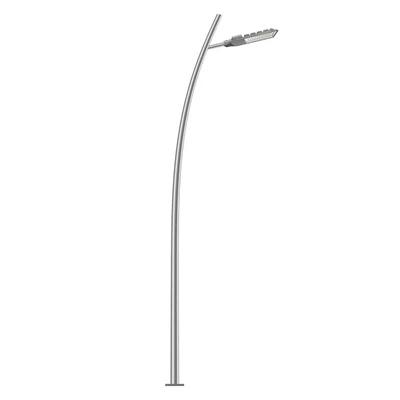
How to Choose the Right Material of Street Light Poles?
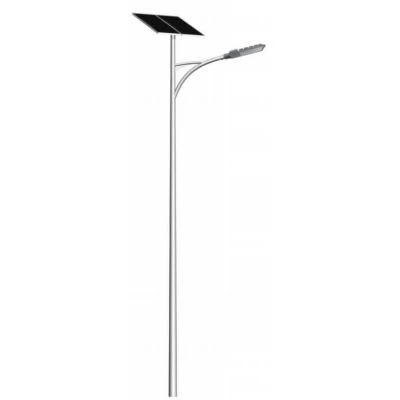
The decision between steel tubular poles and wooden poles should hinge on the project’s specific requirements and conditions. Here are some considerations.
Application: The intended use of the poles is important. For heavy-duty applications, such as supporting large transformers or high-voltage lines, steel tubular poles are the preferred choice.
Environmental Considerations: Given the current emphasis on environmental sustainability, it’s worth noting that steel is highly recyclable and can be repurposed numerous times. This makes steel poles an environmentally conscious choice.
Budget: While the upfront cost of steel poles might be steeper, it’s crucial to factor in the long run. Their minimal maintenance, reduced repair frequency, and extended lifespan can make the initial investment worthwhile.
- Taller poles can be placed further apart from each other because the light spread from the fixture will be wider.
- The width of the street will also determine how the light poles will be spaced. Narrow streets will not require the same amount of lighting as wide streets.
- If the distance between the poles is too far, there will be dark spots between the poles. If the distance between the poles is too close, there will be bright spots between the poles. In both cases, the lighting will be uneven and not uniform across the roadway.
- As a rule of thumb, the spacing between the light poles should be 2.5 to 3 times their height. For example, if you are using 30-foot poles for your light fixtures, a 75- to 90-foot spacing between poles is recommended.
- Another thing to consider regarding street light spacing is the arrangement of the light poles. This will be dependent on the width of the street. Here are a few general tips:
- For streets that are over 65 feet wide, you’ll want to have the poles symmetrically arranged on both sides (across from each other).
- For streets that are 51 to 65 feet wide, you’ll want to have the poles arranged and intertwined with each other (opposite or shifted) on both sides.
- For streets that are 50 feet wide or less, you’ll want to have the poles arranged on one side.
- For wider streets that have a divider in between lanes, you can place additional poles in the center with two fixtures mounted on each one to illuminate both sides.
Before Installation, Here’s What You Need to Know
- Understand your town's requirements before you proceed. The installation of light poles and the mounting height of luminaires are determined by local ordinances. Each area will have its requirements.
- Installation requirements are different for residential and commercial applications. Residential poles can be installed in soil or cement. Commercial poles are usually installed in cement so that they can withstand more rigorous conditions.
- Know what the wind rating (average wind speed) of your area is. Your light pole and its installation type need to be able to handle the wind load that it will experience. This is a major safety requirement.
Two General Types of Light Pole Installations
Direct burial method of light pole installation
As the name itself suggests, a direct burial method of pole installation allows you to install a pole right into the ground. Herein, you don’t even need rebars or concrete filling, as the light pole stands firmly by itself. It is also called the embedded method, this is by far the most cost-efficient way of installing a street or residential light pole. That’s because it eliminates various steps of installation while also significantly reducing the material requirement.
Direct installation means the pole will be in direct contact with the soil and exposed to wear from rust. Meaning when using the direct burial method, you might have to limit yourself to either fiberglass or aluminum as the light pole materials since they’re rust-free.
This method is not ideal for all locations and can only be used at places that have firm soil. So you can’t use direct burial for areas with sandy, wet, or loose soil.
Anchor-based method lighting pole installation
Compared to direct burial, an anchor-based pole installation will need a lot more time and investment. That’s because such an installation will include all the steps that we discussed earlier. Nevertheless, this method offers the most solid pole installation and is thus the ideal solution for certain locations. In addition, light pole replacement is super easy with the anchor-based method.
Now, when it comes to using this method, there are two foundation-building methods you can follow, namely:
Concrete foundation
This foundation building method follows exactly what we discussed in the pole installation steps, including excavation, concrete porting, and attaching anchor bolts.
Helix foundation
Helix foundations are different from concrete foundations, and they use the same method as seen in power distribution lines and mobile phone towers, among others.
Herein, you need not use any concrete at all, as the grounded anchors and a helix-shaped plate hold every component of the light pole firmly in place.
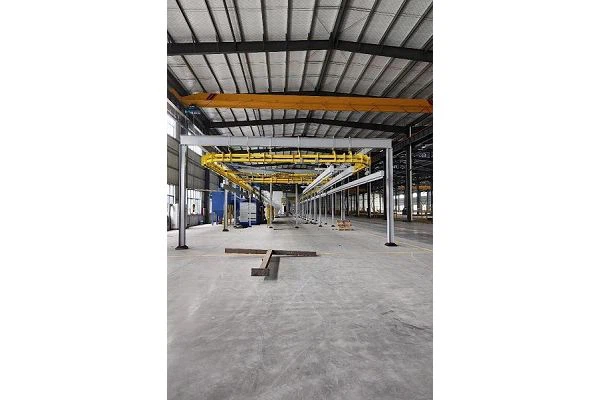
Our Factory


Our Certificates


FAQ
Q: How do you protect lamp posts?
Q: What is the life expectancy of a steel pole?
Q: How to calculate street light pole weight?
Q: Which Industries Should Choose Steel Light Poles?
Parks and locations that feature tennis courts, basketball courts, baseball fields, soccer fields, or football Highways, roads, and residential streets, Industrial, Warehouse, Car dealerships or rent-a-car parking lots, Large parking lots, Elementary school, middle school, high school, college, or university campuses.
Q: What Are The Advantages of Steel Light Poles?
Strong enough to mount multiple lights
Easy installation
Easy to modify in the field
Q: Can I purchase street light poles in bulk for wholesale?
Q: Can I order samples before placing a bulk order?
Q: How long do street light poles typically last?
Q: How do street light poles improve security?
Q: Is there any savings on costs associated with street light poles that are fabricated?
Q: Which type of pole is used for lighting?
Q: What are the applications of street light poles?
Major local roads
V category Roadways
P category Roadways
Intersections
Roundabouts
Q: What is the standard height of a street light pole?
Q: How many types of street light poles are there?
Polygonal/Octagonal Poles: Polygonal/Octagonal Poles are a type of street light pole that is characterized by their eight-sided shape. These poles are typically made from steel or concrete, and they are often used in areas where traditional round poles would be impractical or unsafe.
Steel Tubular Poles: Steel tubular poles are a type of street light pole that is made out of steel tubing. These poles are generally used in urban areas and are often used to support high-powered lamps. Steel tubular poles are usually much taller than other street light poles, which helps increase the visibility of the area in which they are installed.