


Solar Street Light
Founded in 2009, FOREVER LIGHTING is a pioneer in steel poles, solar street lighting, and energy management. We are dedicated to technology innovation, to satisfy customers' needs with our profession and efficiency, and offer the most reliable and lasting steel pole, led street light, and solar street lighting technology. The advantage of our products comes from product quality and cutting-edge technology. Our vision lies in bringing people a lighter future and building our international brand.
Why choose us
Advanced Equipment
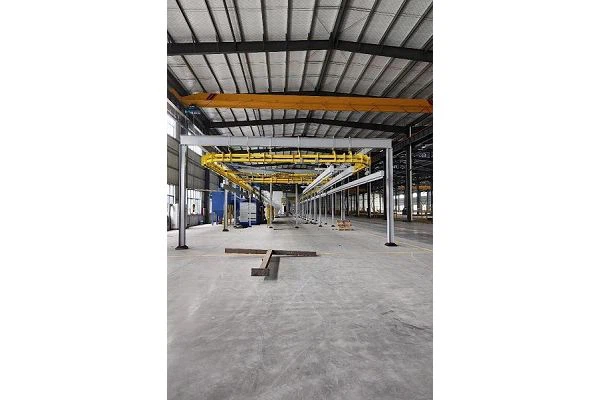
We own advanced high-tech full automatic numerical control mechanization production and inspection machines mainly for lighting poles, LED lamps, solar panels lithium batteries, etc.
Competitive Price
With Lower production costs, we enjoy more pricing advantages. Hence we provide competitive prices for customers around the world as much as possible to achieve win-win.
Broad Market
Now we are present in more than 117 countries and regions around the world. We export about 100,000 streetlights per year, bringing public lighting to rural areas without electricity while also accompanying the development of smart cities.
Quality Guaranteed
We take great importance on quality management systems in each process. Each of our products has passed the Raw Material&Semi-Products testing and verification. In addition, warranty statements are also available.
Good Service
We will assist you in all stages from the initial analysis of the project, with the most suitable solar solutions provided by our experts which in compliance with current lighting standards and your budget.
Complete Qualifications
Our factory has passed ISO9001, ISO14001, and ISO45001 certifications, and street lighting products have passed CE, IEC, ROHS, etc certifications and IP66, IES, LM80 tests, etc. If you have some other certificates for specific project requirements, pls consult us.


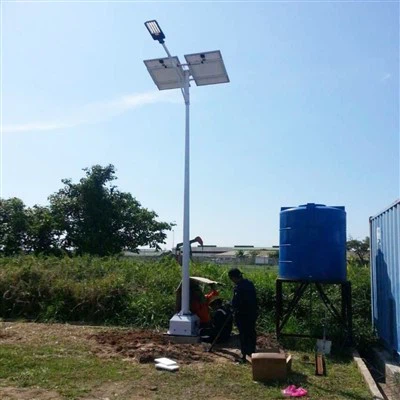

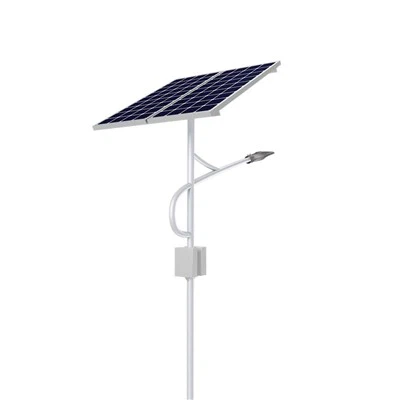


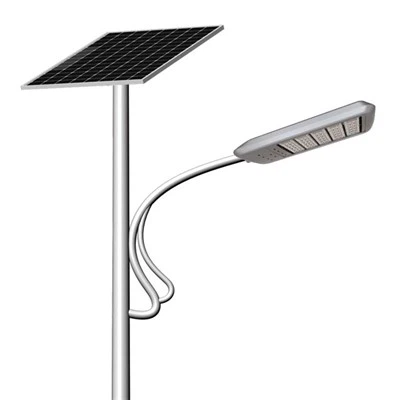


About Solar Led Street Light
Solar energy is inexhaustible, inexhaustible, clean and non-polluting, renewable green energy. The working principle of solar street light is that under the control of intelligent controller during the daytime, the solar panel absorbs sunlight and converts it into electricity. During the daytime, the solar cell module charges the battery, and at night, the battery supplies power to the LED light source to realize the lighting function. The DC controller ensures that the battery pack is not damaged by overcharging or over-discharging, and has the functions of light control, time control, temperature compensation, lightning protection, etc.
Our LED Solar Street Lights Have The Following Advantages
Good Stability
High Luminous Efficiency
Environmental Protection
Energy Saving
Long Life
High Safety Performance
Easy Installation And Maintenance
Economic And Practical
Introduction of Solar Street Light
Solar energy is inexhaustible, inexhaustible, clean and non-polluting, renewable green energy. The working principle of solar street light is that under the control of an intelligent controller during the daytime, the solar panel absorbs sunlight and converts it into electricity. During the daytime, the solar cell module charges the battery, and at night, the battery supplies power to the LED light source to realize the lighting function. The DC controller ensures that the battery pack is not damaged by overcharging or over-discharging, and has the functions of light control, time control, temperature compensation, lightning protection, etc.
Simple installation
Solar streetlights feature little glare, are waterproof, resistant to water, and have a low insect attrition rate. These lights have solar panels that convert solar energy into electrical energy, which is used for dusk-to-dawn illumination operations and stored in the built-in battery. The installation of solar LED street lights is simple and convenient because no extra wiring is needed. It only requires a concrete base and a battery box. Installation does not require extensive labor, materials, and other costs.
Energy-saving and eco-friendly
Solar street lights convert sunlight into electricity without power consumption. No pollution and no radiation are in line with the current environmental protection concept. With LED sources, it can be said to be the icing on the cake.
Safety
Traditional LED street lights may have potential safety hazards due to construction quality, material aging, power supply confusion, and other reasons. While solar LED street lights do not use alternating current, there is no potential safety hazard, which brings convenience to electricians to maintain lamps.
Durable
Most solar panels on the market are stable for at least ten years due to mature manufacturing technology. They can generate electricity for thirty years or more.
High technical content and low maintenance cost
The solar street light is regulated by a solar charge controller, which can adjust the light intensity according to the natural brightness and people’s needs. In remote areas, the daily maintenance costs of traditional street lights are very high. The solar street lights only need regular inspections, and the maintenance cost is relatively low.
Short payback period
Solar LED street lights do not need to pay electricity bills, and in this era of high energy prices, the payback time is greatly shortened.
Common Types of Solar Street Light
Integrated Solar Street Lights
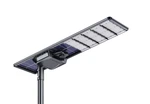
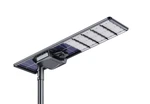
Integrated solar street lights, as the name suggests, integrate the solar panel, battery, controller, LED light source, and other components into a single fixture. Their key features include a compact design and straightforward installation. Simply mount the entire fixture in your desired location, and you're good to go. Integrated solar street lights are ideal for lighting up smaller roads, sidewalks, gardens, residential areas, and other locations where simplicity and ease of installation are paramount.
Semi-Integrated Solar Street Lights
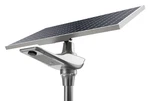
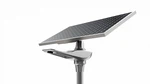
In contrast, semi-integrated solar street lights separate the solar panel from the lighting fixture. Solar panels are often installed on top of the light pole or nearby structures, while the lighting fixtures are placed where illumination is required. This design provides greater flexibility as it allows you to choose the appropriate type and number of lighting fixtures based on your specific lighting needs. Semi-integrated solar street lights excel in larger roadways, squares, parking lots, and areas with higher lighting demands.
Components of Solar Street Light


Solar panel
The solar panel is one of the most important parts of a solar street light, as the solar panel can convert solar energy into electricity that the lamps can use. There are two types of solar panels commonly used in solar street lights: monocrystalline and polycrystalline. The conversion rate of mono-crystalline solar panels is much higher than their poly-crystalline counterparts. Solar panels also vary in wattage systems.
Lighting fixture
LEDs are usually used as the primary lighting source of modern solar street lights, as the LED will provide much higher luminosity with lower energy consumption. The energy consumption of an LED fixture is at least 50% lower than the HPS fixture counterpart which is widely used as the lighting source in traditional street lights. A lack of warm-up time in LEDs also allows for the use of motion detectors for additional efficiency gains.
Rechargeable battery
Batteries will store the electricity generated by the solar panel during the day and provide energy to the fixture during the night. The life cycle of the battery is very important to the lifetime of the light and the capacity of the battery will affect the backup days of the lights. There are two types of batteries commonly used in solar-powered street lights- gel cell deep cycle batteries as well as lead acid batteries. Lithium-ion batteries are also popular due to their compact size.
Pole
Strong poles are necessary for all street lights, especially for solar street lights as there are often components mounted on the top of the pole: fixtures, panels, and sometimes batteries. However, in some newer designs, the PV panels and all electronics are integrated into the pole itself. Wind resistance is also a factor.
Cost Efficiency: Conventional street lights require ongoing electricity costs, while solar street lights harness the power of the sun, providing a cost-effective and sustainable lighting solution.
Energy Efficiency: Smart solar LED lights operate using renewable solar energy, reducing dependence on non-renewable resources. Conventional street lights rely on grid power, which may be subject to fluctuations and energy loss during transmission.
Environmental Impact: Solar street lights produce zero greenhouse gas emissions and contribute to reducing carbon footprints. Conversely, conventional street lights rely on fossil fuels and contribute to air pollution and climate change.
Maintenance Requirements: Solar street lights have minimal maintenance needs, with longer lifespans and fewer components to replace. Conventional street lights require regular maintenance, bulb replacements, and wiring upkeep.
Reliability: Solar street lights can operate independently of the power grid, ensuring uninterrupted lighting even during power outages. Conventional street lights are susceptible to power disruptions and rely on a functioning grid.
How To Choose Solar Street Light?
When choosing a solar street light, here are some factors to consider:
Lighting requirements: Determine the level of brightness and the area you need to illuminate. This will help you determine the wattage and lumens required for your solar street light.
Solar panel efficiency: Consider the efficiency of the solar panels used in the street light. Higher efficiency will ensure better performance and faster charging of the battery.
Battery capacity: The battery capacity should be sufficient to store enough energy to power the light during nights and cloudy days. Consider the battery's storage capacity and its lifespan.
Weather resistance: Choose a solar street light that is designed to withstand various weather conditions, including heat, cold, rain, and strong winds. Look for IP65 or IP66 ratings to ensure durability.
Motion sensor capabilities: If you want a solar street light with a motion sensor, ensure that it has adjustable settings to control the sensitivity, range, and duration of the sensor.
Mounting options: Consider the available mounting options, such as pole mount, wall mount, or ground mount, and choose the most suitable option for your installation location.
Warranty and after-sales service: Check the warranty offered by the manufacturer and the availability of reliable after-sales service.
Budget: Set a budget based on your requirements and research different brands and models within that price range. Compare the features and specifications to make an informed decision. By considering these factors, you can choose a solar street light that meets your specific needs and ensures efficient and reliable performance.
Maintenance Tips for Solar Street Light
Inspect the Solar Panel for Dirt or Debris
The solar panel is essential for your solar street light and needs to be kept clean for optimal performance. Inspect the panel regularly for dirt or debris, and gently wipe it away with a soft cloth if necessary. You should also check the panel regularly for cracks or other damage and have it replaced if necessary. The light fixture is the final part of your solar street light, and it needs to be checked for damage regularly. Inspect the fixture for cracks, breaks, or other damage, and have it replaced if necessary.
Check to Make Sure the Light is Facing in the Correct Direction
The angle at which the solar panel is mounted will determine how much sunlight it receives throughout the day, and if it isn’t installed correctly, your light may not get enough power to stay lit all night.
Use a level to check that the solar panel is mounted horizontally, and adjust it if necessary. Then, use a compass to ensure the panel is facing true north.
Clear any Obstructions Around the Light that Might Block Sunlight
One of the most common reasons that prevents light from working is that they are pointing in the wrong direction and are being obstructed. Check on your lights regularly to ensure that nothing is blocking them from getting direct sunlight.
Replacing Parts as Needed
The most common factors that need to be replaced are the batteries, the solar panel, and the light fixture. Batteries typically need to be replaced every two to three years, depending on how often they are used. Solar panels usually last about five years, but they can also be damaged by debris or lousy weather. Light fixtures typically need to be replaced every ten years, but severe weather conditions can also damage them.
Our Factory


Our Certificates


FAQ
Q: How much does a solar powered street light cost?
Q: Does solar street light works on cloud day or rainy day?
Q: What is the battery life of solar street lights?
Q: How to choose solar street light?
Q: Why using solar street lights is an advantage?
Q: What is the function of smart solar street lights?
Q: How efficient are solar street lights?
Q: How to install solar street lights?
The Light arm to fix the luminary has to be fixed along with the pole.
The Solar panel has to be mounted on the solar panel mounting structure.
The LED luminary has to be fixed on the luminary.
The wiring from the solar panel to the LED luminary with an inbuilt charge controller has to be done. The wiring has to be concealed inside the pole. In the case of an external charge controller, the wiring has to be done from the solar panel and the luminary to the charge controller. In either case, the wiring from the luminary to the battery has to be made. However, the battery has to be fixed only after the erection.
The pole is erected on the ground pit. The pit has to be covered with concrete mix.
After the pole can stand on its own, the battery can be kept inside the battery box and the connections can be completed by connecting the wire from the luminary/charge controller with the battery.
(For the best view on mobile, rotate the device horizontally)
Q: How Do Solar Lights Work?
Charge Controller: A charge controller is used to regulate the voltage and current from the solar panels and prevent overcharging or deep discharging of the batteries. It ensures the batteries are charged optimally and safely.
Batteries: The electricity generated by the solar panels is stored in rechargeable batteries, typically deep-cycle batteries. These batteries store energy during the day to power the lights at night when there is no sunlight.
LED Lamps: High-efficiency LED lamps are used as the light source in solar street lights. LED technology is chosen for its energy efficiency, durability, and brightness. The LEDs are powered by the energy stored in the batteries.
Light Control: A light control system, often integrated with a timer or a light sensor (photocell), is used to automatically turn the LED lamps on at dusk and off at dawn or at a specific preset time. Some systems can also adjust the brightness of the lamps based on ambient light conditions.
Pole and Mounting: The solar panels, LED lamps, batteries, and other components are typically mounted on a sturdy street light pole, which is installed at the desired location. The height and design of the pole can vary depending on the specific application and aesthetic preferences.
Q: I'm in an area where we would like the lights to dim late at night and come back to full brightness before sunrise - is this possible?
Q: What kind of maintenance should be done on solar streetlights?
Q: Which are the information you should give us to best customize the solar lights?
Q: Do solar LED lights need direct sunlight?
Q: How many watts are needed in one solar street light?