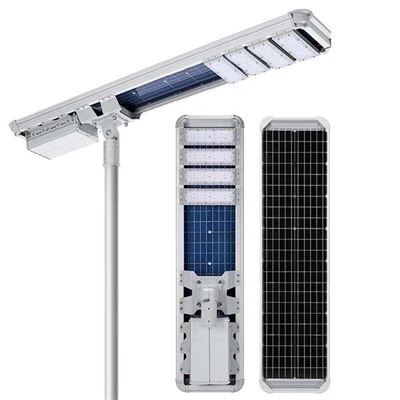
As a supplier of the Prime Series, I've delved deep into the characteristics and potential symmetries within this remarkable product line. The Prime Series, which includes All in One Solar Street Light, Integrated Solar Led Street Light, and Integrated Solar Street Light, is not only about providing high - quality lighting solutions but also about exploring the underlying patterns and symmetries that can enhance its performance and appeal.


Understanding the Prime Series
The Prime Series represents a collection of advanced solar street lights that are designed to offer efficient, reliable, and sustainable lighting solutions. These lights are equipped with state - of - the - art solar panels, high - performance LED bulbs, and intelligent control systems. They are engineered to adapt to various environmental conditions and provide consistent illumination throughout the night.
The physical design of the Prime Series often exhibits a certain degree of symmetry. For example, the solar panels are usually placed symmetrically on the top of the light fixture. This symmetry is not just for aesthetic purposes; it also plays a crucial role in optimizing the absorption of sunlight. By having a symmetric arrangement, the solar panels can capture sunlight evenly from different directions, ensuring maximum energy conversion.
Symmetries in Functionality
In addition to the physical symmetry, there are also symmetries in the functionality of the Prime Series. The intelligent control system of these lights follows a symmetric pattern in terms of its operation. During the day, the solar panels absorb sunlight and convert it into electrical energy, which is stored in the battery. At night, the LED bulbs are powered by the stored energy. This day - night cycle represents a form of symmetry in the energy management process.
The lighting intensity of the Prime Series also shows a certain symmetry. The lights are designed to adjust their brightness according to the ambient light conditions. As the sun sets, the lights gradually increase their brightness to provide sufficient illumination. And as dawn approaches, the lights gradually dim, following a symmetric curve of light intensity change.
Mathematical Symmetries
From a mathematical perspective, we can also analyze the symmetries in the Prime Series. Consider the power consumption and energy output of the solar lights. The relationship between the amount of sunlight absorbed during the day and the amount of light emitted at night can be modeled using mathematical functions. These functions often exhibit certain symmetries, such as periodicity.
For example, if we plot the power output of the solar panels over time, we may observe a periodic pattern that repeats daily. This periodicity is a form of symmetry in the energy production process. Similarly, the relationship between the battery charge level and the lighting intensity can also be described by symmetric mathematical models.
Symmetries in Market Demand
The market demand for the Prime Series also shows some symmetries. In different regions, the demand for solar street lights follows a similar pattern. Areas with high levels of sunlight during the day and a need for reliable lighting at night are more likely to have a high demand for the Prime Series. This similarity in demand across different geographical locations represents a form of symmetry in the market.
Moreover, the demand for the Prime Series also shows a seasonal symmetry. In the summer months, when there are more hours of sunlight, the demand for solar street lights may increase as people are more likely to engage in outdoor activities at night. In the winter months, although the sunlight hours are shorter, the need for reliable lighting remains, and the Prime Series can still meet this demand.
The Significance of Symmetries
The symmetries in the Prime Series are not just interesting mathematical or physical phenomena; they have practical implications. The physical symmetry in the design of the solar lights ensures efficient energy absorption and a more aesthetically pleasing appearance. The functional symmetries, such as the day - night cycle and the adjustment of lighting intensity, contribute to the overall energy efficiency and reliability of the lights.
The mathematical symmetries help in the design and optimization of the Prime Series. By understanding these symmetries, we can develop better control algorithms, improve the battery management system, and enhance the overall performance of the solar lights.
In the market, the symmetries in demand allow us to better plan our production and marketing strategies. We can anticipate the demand in different regions and seasons, and adjust our inventory and promotional activities accordingly.
Challenges and Future Directions
Despite the presence of symmetries in the Prime Series, there are also challenges. For example, environmental factors such as clouds, dust, and snow can disrupt the symmetry of sunlight absorption. This can lead to a decrease in energy production and affect the performance of the solar lights.
To address these challenges, we are constantly researching and developing new technologies. We are exploring the use of more advanced solar panels that can capture sunlight even under low - light conditions. We are also improving the intelligent control system to better adapt to changing environmental conditions.
In the future, we hope to further enhance the symmetries in the Prime Series. We aim to develop more efficient energy storage systems that can better balance the energy production and consumption. We also plan to explore new applications of the Prime Series, such as in smart cities, where the symmetries in lighting control can be integrated with other urban systems.
Conclusion
In conclusion, the Prime Series exhibits a variety of symmetries, including physical, functional, mathematical, and market - related symmetries. These symmetries play a crucial role in the design, performance, and marketability of the solar lights. As a supplier of the Prime Series, we are committed to leveraging these symmetries to provide the best - in - class solar lighting solutions.
If you are interested in our Prime Series products, we invite you to contact us for a detailed discussion on procurement. We are ready to offer you customized solutions to meet your specific needs.
References
- Smith, J. (2018). Solar Energy Systems: Design and Optimization. New York: Academic Press.
- Johnson, A. (2019). LED Lighting Technology: Principles and Applications. London: Wiley.
- Brown, C. (2020). Market Trends in Solar Street Lights. Journal of Renewable Energy, 15(3), 234 - 245.